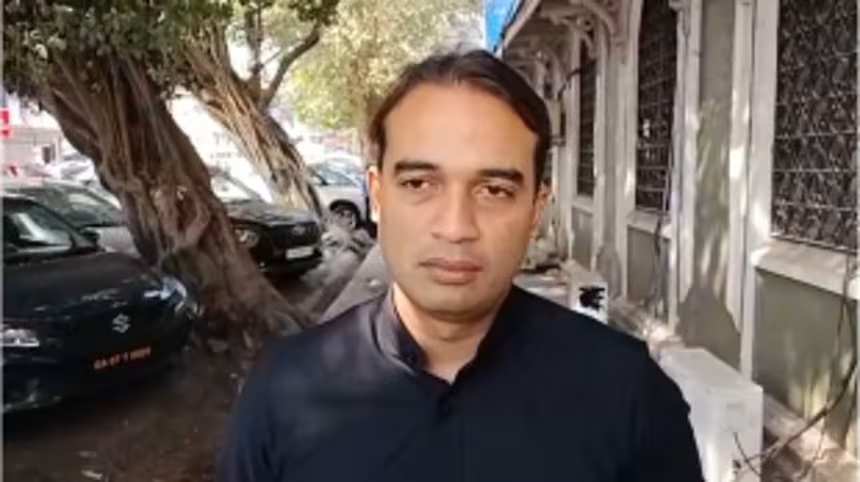
Rohit Monserrate, Mayor of the Corporation of the City of Panaji, has categorically rejected allegations surrounding a purported casino proposal in Panaji. Responding to criticism from select quarters, he clarified that no formal proposal exists and emphasized that the municipal corporation does not possess authority to issue casino licences. Labeling the accusations as politically motivated and defamatory, the Mayor stated that he had officially communicated the cancellation of a related meeting to relevant authorities. While expressing personal reservations about gambling, he acknowledged casinos’ economic role and invited critics to propose viable alternatives.
Allegations and Political Undertones
The controversy emerged after claims circulated suggesting that the Panaji municipal administration was considering a proposal related to casino operations within city limits. Mayor Rohit Monserrate firmly denied these assertions, stating that the criticism was based on misinformation and selective interpretation of events.
Addressing the issue publicly, Monserrate emphasized that he represents approximately 22,000 residents of Panaji and cannot be guided by the views of “three signatories.” He characterized the allegations as an attempt at political point-scoring, asserting that the episode amounted to “cheap politics and character assassination.”
According to the Mayor, he had formally informed concerned authorities regarding the cancellation of the meeting in question and maintains documentary evidence to substantiate his position.
Regulatory Authority and Licensing Clarity
A key element of Monserrate’s response focused on regulatory jurisdiction. He clarified that the Corporation of the City of Panaji does not issue casino licences, underscoring that such authority lies beyond the municipal body’s mandate.
This distinction is significant in the context of Goa’s regulatory framework for offshore and onshore gaming establishments. By reiterating the corporation’s limited administrative role, the Mayor sought to dispel suggestions that local civic leadership could unilaterally approve or facilitate casino expansion.
Experts note that misunderstandings regarding regulatory hierarchies often fuel political disputes, particularly in sectors involving tourism and entertainment where state-level permissions dominate.
Economic Realities and Employment Considerations
While distancing himself from support for gambling, Monserrate acknowledged the economic dimension of casinos in Goa. He stated that, irrespective of personal opinion, gaming establishments generate employment and provide indirect support to ancillary sectors such as hospitality, transportation and small-scale retail.
Goa’s tourism-driven economy relies significantly on diversified revenue streams, and casinos have historically contributed to state-level tax inflows running into hundreds of crores of rupees annually. Industry observers argue that abrupt policy shifts without structured alternatives could disrupt employment networks and business ecosystems linked to the sector.
The Mayor urged critics to present a detailed and economically sustainable alternative plan if they advocate removal of casino operations.
Governance, Accountability and Public Mandate
Monserrate’s remarks reflect a broader debate about governance accountability and public representation. By emphasizing his electoral mandate, he signaled that municipal leadership must balance ethical perspectives, economic considerations and administrative limitations.
Political analysts observe that controversies tied to high-revenue industries often intensify ahead of electoral cycles, with public sentiment leveraged for strategic positioning. In such circumstances, clear communication and documentary transparency become essential tools in maintaining institutional credibility.
The Road Ahead
As the debate unfolds, the immediate focus appears to be on clarifying facts and jurisdictional boundaries rather than introducing new policy measures. The Mayor’s insistence on documentary proof and procedural transparency indicates a defensive but assertive posture.
For Panaji’s residents and business stakeholders, the episode underscores the complexity of managing tourism-centric urban economies. Beyond rhetoric, sustainable policy discourse will likely depend on data-driven analysis, regulatory clarity and consensus-building among civic, state and commercial actors.
Whether the controversy dissipates or evolves into a broader political contest remains to be seen. For now, municipal leadership maintains that no casino proposal exists and that governance decisions must be grounded in law, mandate and economic pragmatism rather than speculation.
Comments