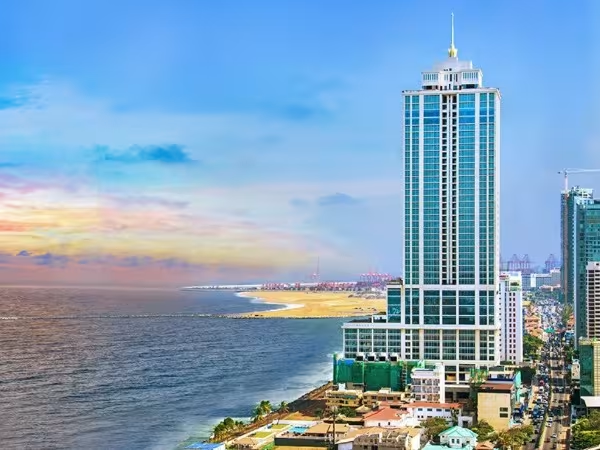
Sri Lanka’s long-delayed Hyatt Tower project in Colombo has re-emerged as a focal point for policymakers and investors, with discussions increasingly centering on the potential inclusion of a casino license. As authorities move to divest Canwill Holdings, the state-owned entity controlling the unfinished waterfront skyscraper, prospective bidders are closely examining the regulatory landscape governing gaming operations. The transferability or availability of a casino license has surfaced as a decisive factor influencing valuation and financial feasibility. Government officials have refrained from offering definitive guidance, instead urging bidders to conduct independent legal due diligence on Sri Lanka’s gaming laws.
A Stalled Landmark Returns to the Negotiating Table
The skeletal structure of the Hyatt Tower has dominated Colombo’s waterfront skyline for years, symbolizing both ambition and delay. Conceived as a flagship hospitality and mixed-use development, the project stalled amid financial constraints and governance complexities.
Now, with the government seeking to divest Canwill Holdings and revive investor confidence, the unfinished tower is back under scrutiny. The renewed effort reflects broader fiscal pressures and a policy shift toward unlocking value from dormant state assets.
Casino Licensing Emerges as a Core Valuation Driver
At a recent pre-bid conference for the sale of Canwill Holdings, attention shifted from construction timelines and capital expenditure requirements to a more strategic question: gaming rights. One prospective investor directly queried whether a casino license would be available to a new owner and, if so, whether such a license could be transferred or newly issued.
The inquiry underscored a broader investment thesis—integrating regulated gaming operations could materially enhance revenue projections, improve cash-flow visibility and strengthen return-on-investment metrics. In hospitality-led real estate, gaming often acts as a high-margin anchor, elevating average daily rates, footfall and ancillary spending.
For bidders evaluating an incomplete skyscraper requiring substantial capital infusion, clarity on gaming permissions could significantly alter risk-adjusted valuations.
Government Maintains Cautious Position
Representatives from Sri Lanka’s Finance Ministry refrained from offering a definitive answer regarding casino licensing. Instead, they advised potential investors to seek independent legal counsel to interpret the country’s gaming regulations and assess how such laws may influence ownership or operational rights tied to the property.
This position signals regulatory sensitivity. Gaming remains a politically and socially nuanced issue in Sri Lanka, balancing potential fiscal benefits against public policy considerations. By directing investors toward legal due diligence rather than issuing explicit assurances, the ministry has effectively placed the compliance burden on bidders.
Regulatory Risk and Investment Strategy
From a capital markets perspective, uncertainty around licensing introduces measurable regulatory risk. Investors typically price such ambiguity into acquisition bids, either through discounted valuations or conditional offer structures.
If a casino component were permitted, the tower’s revenue model could transition from a conventional hospitality-led structure to a diversified leisure and entertainment asset. Conversely, absence of gaming rights may constrain revenue scalability, lengthening payback periods and compressing internal rates of return.
In emerging markets, regulatory clarity often determines whether projects attract strategic global operators or remain dependent on local capital pools.
Broader Economic Implications
The outcome of the Hyatt Tower divestment carries implications beyond a single development. A successful transaction would signal Sri Lanka’s willingness to recalibrate asset monetization strategies amid fiscal consolidation efforts. It would also test investor appetite for large-scale mixed-use projects in a market navigating macroeconomic recovery.
Should gaming approval become part of the equation, it could reshape Colombo’s hospitality landscape and position the waterfront as a more competitive regional tourism hub.
The Road Ahead
For now, the future of the Hyatt Tower remains intertwined with legal interpretation and policy direction. Investors appear keenly aware that the value of the unfinished skyscraper may depend less on its concrete frame and more on regulatory permissions yet to be clarified.
As negotiations advance, one issue stands above all others: whether gaming rights will transform a dormant landmark into a commercially viable centerpiece of Colombo’s evolving skyline.
Comments