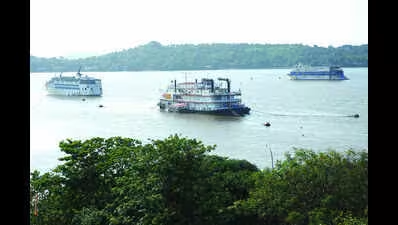
A group of lawyers has begun drafting a writ petition to challenge regulatory approvals granted for Delta Corp’s proposed 112-meter offshore casino vessel in Goa. The legal effort, undertaken on a pro bono basis, is expected to culminate in a petition before the Bombay High Court. Former Allahabad High Court Chief Justice Ferdino Rebello confirmed that the filing is imminent. The move introduces fresh legal uncertainty for the gaming operator’s expansion plans and underscores ongoing tensions surrounding offshore casino regulation in the coastal state. The case could carry broader implications for governance, environmental oversight and the gaming industry’s operating framework.
Fresh Legal Scrutiny for Offshore Gaming Expansion
Regulatory approvals granted to Delta Corp for its planned 112-meter offshore casino vessel are set to face judicial examination, as a group of lawyers prepares to file a writ petition before the Bombay High Court.
The legal initiative, being undertaken pro bono, seeks to challenge the permissions issued for the new floating casino project in Goa. Former chief justice of the Allahabad High Court, Ferdino Rebello, confirmed that the petition is in advanced stages of preparation and will be filed shortly.
The development signals renewed scrutiny of offshore gaming operations in the state.
Regulatory Permissions Under the Lens
The proposed vessel, measuring 112 meters in length, represents a significant addition to Delta Corp’s offshore portfolio. Floating casinos have long operated along Goa’s waterways under a specific regulatory framework that distinguishes them from land-based establishments.
However, approvals for new or expanded gaming infrastructure frequently attract legal and civic challenges. Critics often question environmental clearances, zoning compliance and broader public policy considerations.
The forthcoming writ petition is expected to contest the procedural and substantive aspects of the permissions granted, though detailed grounds are yet to be publicly disclosed.
Legal Strategy and Broader Implications
A writ petition allows petitioners to seek judicial review of administrative decisions, particularly when questions arise regarding constitutional compliance or statutory interpretation. Filing before the Bombay High Court places the matter squarely within a forum empowered to examine state-level regulatory actions.
If admitted, the case could result in interim relief measures, potentially affecting timelines for the offshore casino’s commissioning.
For Delta Corp, the development introduces a layer of operational uncertainty. The company, which holds a dominant position in India’s organized gaming sector, has consistently emphasized regulatory adherence in its expansion strategy.
Economic Stakes and Policy Debate
Goa’s offshore casino industry contributes meaningfully to the state’s tourism economy, generating employment and tax revenues. At the same time, the sector remains politically sensitive, with periodic calls for tighter oversight or relocation.
Legal challenges often reflect broader societal debates about balancing economic growth with environmental stewardship and public morality considerations.
A judicial review of the latest project may therefore extend beyond a single vessel, potentially influencing future licensing decisions and regulatory processes.
Outlook: A Test Case for Governance
As the petition moves toward filing, stakeholders across the gaming and tourism industries will be monitoring proceedings closely. Judicial intervention, if any, could redefine compliance benchmarks and reshape expansion strategies in the offshore gaming segment.
The episode underscores the intricate interplay between commerce, law and public policy. In sectors as regulated and contentious as gaming, growth initiatives frequently encounter courtroom scrutiny — a reminder that regulatory approval does not always mark the final chapter in major infrastructure projects.
Comments