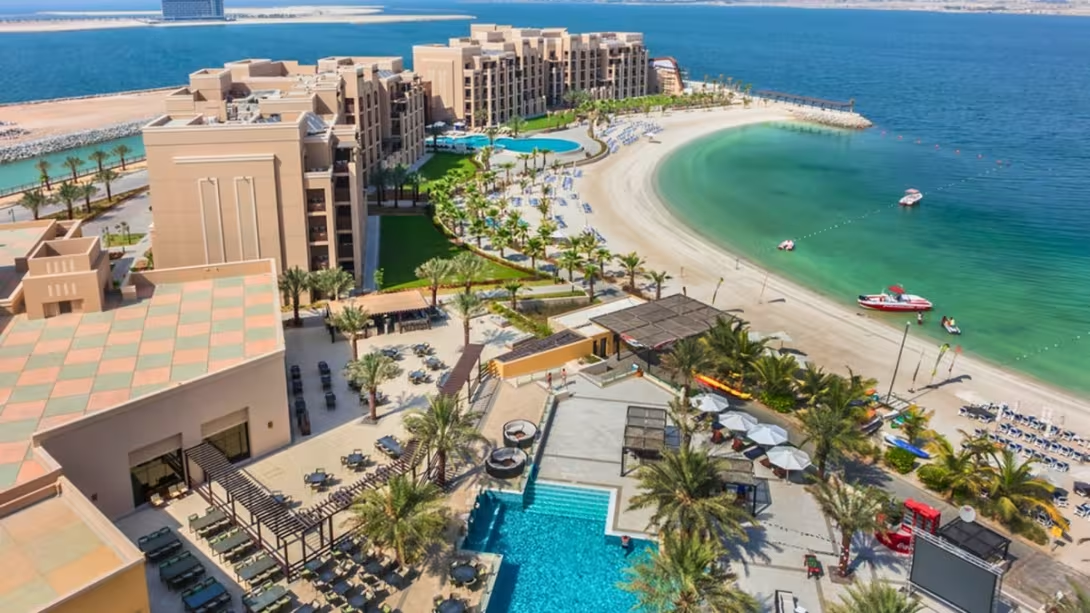
Ras Al Khaimah, long regarded as a quieter counterpart to Dubai, is positioning itself for a dramatic tourism surge, targeting 5.5 million annual visitors by 2030, up from 1.28 million in 2024. Unlike growth driven by global expos or mega sporting events, this expansion hinges largely on a landmark integrated resort featuring a casino. The development signals a strategic pivot for the northernmost UAE emirate, aiming to diversify its economy, attract foreign investment and elevate its global hospitality profile. The initiative could redefine regional tourism dynamics and reshape the Gulf’s entertainment landscape.
From Quiet Emirate to Strategic Contender
For decades, Ras Al Khaimah was perceived as a tranquil alternative within the United Arab Emirates, overshadowed by Dubai’s skyscrapers and Abu Dhabi’s oil-backed grandeur. Its appeal rested on natural landscapes, mountains and coastal resorts rather than large-scale entertainment infrastructure.
In 2024, the emirate recorded 1.28 million visitors, a respectable figure but modest compared with its southern neighbors. Now, authorities are projecting a fourfold increase to 5.5 million annual tourists by 2030. The driving force behind this ambitious target is a single transformative project: a casino-integrated resort.
This marks a significant departure in a region historically cautious about regulated gaming.
The Casino as Economic Catalyst
The proposed integrated resort is designed to function as more than a gaming venue. Industry models suggest that casinos embedded within luxury hospitality complexes act as anchor assets, stimulating hotel occupancy, retail spending, food and beverage revenue and conference tourism.
Rather than relying on one-off mega-events, Ras Al Khaimah’s strategy centers on permanent infrastructure capable of generating recurring visitor flows. If executed effectively, such developments can increase average visitor spending and extend length of stay, both critical metrics in tourism economics.
The anticipated uplift aligns with broader diversification efforts across the UAE, where non-oil sectors are increasingly prioritized as long-term growth engines.
Tourism Targets and Infrastructure Scaling
Reaching 5.5 million visitors annually will require substantial scaling of supporting infrastructure. Airport connectivity, road networks, hospitality inventory and workforce capacity must expand in tandem with projected demand.
Hotel development pipelines are expected to accelerate, while international brands may view Ras Al Khaimah as an emerging opportunity within a stable regulatory and investment climate. The multiplier effect could extend into real estate, retail and construction sectors.
However, tourism forecasts tied to single landmark projects carry execution risk. Achieving projected footfall depends on regulatory clarity, global marketing strategy and sustained geopolitical stability.
Competitive Dynamics in the Gulf
The Gulf region has traditionally differentiated itself through luxury retail, cultural tourism and large-scale events. Introducing regulated casino gaming adds a new competitive dimension.
By positioning itself as a first mover in the UAE’s emerging gaming framework, Ras Al Khaimah may capture pent-up regional demand. At the same time, it must balance cultural sensitivities and regulatory oversight to ensure long-term viability.
The emirate’s proximity to Dubai—approximately 90 minutes by road—could prove advantageous. Visitors may combine experiences across emirates, reinforcing the UAE’s collective tourism ecosystem rather than fragmenting it.
Economic Diversification and Long-Term Outlook
Beyond visitor numbers, the casino resort represents a broader economic statement. Large-scale integrated resorts typically generate employment across hospitality, technology, compliance and entertainment segments. They also attract international capital and global brand partnerships.
For Ras Al Khaimah, the initiative signals confidence in structural transformation rather than incremental growth. The emirate is effectively leveraging regulated gaming as a catalyst for repositioning itself on the global tourism map.
Whether the 5.5 million visitor target materializes will depend on disciplined execution and sustained demand. Yet the direction is clear: a once-overlooked emirate is making a calculated, high-stakes wager on becoming a premier destination in the Middle East’s evolving tourism economy.
Comments