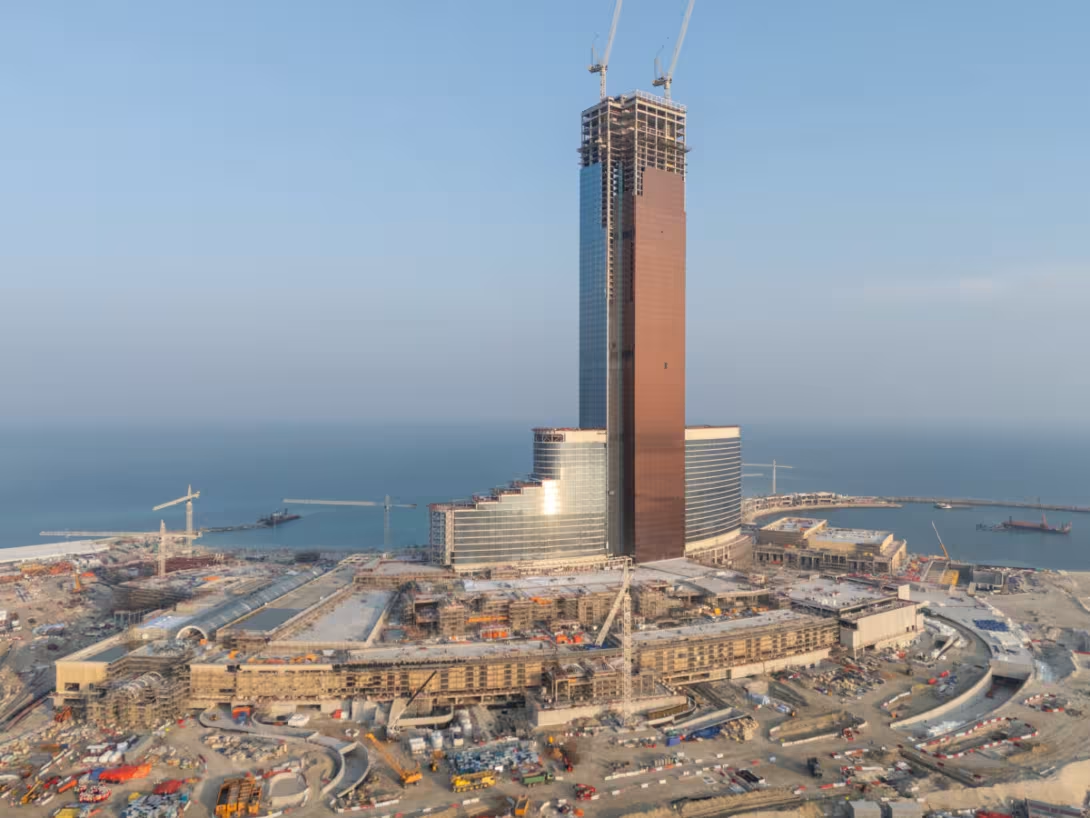
Escalating conflict in the Middle East has introduced fresh uncertainty for U.S.-based casino operators Wynn Resorts and MGM Resorts International, both of which are investing billions of dollars in hospitality and entertainment developments in the United Arab Emirates. The situation intensified after joint U.S.-Israeli airstrikes on Iran triggered retaliatory drone and missile attacks, with reported impacts in Dubai. The U.S. State Department has urged Americans in several regional countries, including the UAE, to depart due to escalating security risks. Company officials say employees remain safe as contingency plans are activated and operations are closely monitored.
Rising Regional Instability and Corporate Exposure
The unfolding geopolitical crisis in the Middle East has prompted heightened vigilance among multinational corporations with exposure to the region. Among them are Wynn Resorts and MGM Resorts International, two Las Vegas-headquartered gaming and hospitality giants pursuing large-scale integrated resort projects in the United Arab Emirates.
The tension escalated following coordinated airstrikes on Iran by the United States and Israel. In response, Iranian forces launched drones and missiles across parts of the region. Two projectiles reportedly struck areas in Dubai, causing damage to hotel properties and infrastructure near Dubai International Airport.
The developments have underscored the vulnerability of high-profile tourism and entertainment investments to geopolitical volatility.
U.S. Advisory Raises Stakes
The United States Department of State issued an advisory urging American citizens in 14 Middle Eastern nations, including the United Arab Emirates, to depart using commercial transportation due to what it described as severe and escalating security risks.
While the advisory does not mandate evacuation, it signals a significant elevation in threat perception. For companies with U.S. personnel stationed abroad, such guidance typically triggers enhanced risk assessments, crisis protocols and internal compliance reviews.
Corporate Response and Employee Safety
MGM Resorts International confirmed that no American citizens are currently assigned to its UAE development project. Company spokesman Brian Ahern said employees on the ground are safe and following local authority directives, including shelter-in-place guidance. Management teams remain in close contact with staff through regular check-ins.
Wynn Resorts also acknowledged active monitoring of the situation. Spokesman Michael Weaver stated that contingency measures are in place to ensure employee safety should conditions deteriorate. The company did not disclose the number of U.S. citizens involved in its UAE operations.
Such responses reflect standard multinational crisis-management frameworks, where employee welfare, operational continuity and reputational safeguards converge.
Strategic Investments at Risk
The UAE represents a strategic frontier for global gaming operators seeking to diversify beyond saturated North American markets. Large-scale resort developments in the Gulf region are designed to capture high-net-worth tourism flows, capitalize on luxury hospitality demand and position operators at the forefront of a potentially liberalizing regional gaming environment.
However, geopolitical shocks can materially alter investment timelines, insurance costs, financing structures and projected returns. Even temporary disruptions may influence contractor mobilization, supply chain logistics and capital expenditure schedules.
From a financial standpoint, prolonged instability could elevate risk premiums and affect investor sentiment toward emerging market hospitality assets.
Navigating Uncertainty
For Wynn and MGM, the immediate priority remains employee safety and asset protection. Over the medium term, the situation will test the resilience of their global expansion strategies.
The UAE has long positioned itself as a stable business hub within a complex regional landscape. Whether current tensions prove transient or structurally destabilizing will shape not only the trajectory of these multibillion-dollar projects but also broader capital flows into Middle Eastern leisure infrastructure.
In an industry where long-term fixed investments intersect with unpredictable geopolitical realities, strategic agility is no longer optional—it is fundamental to sustaining shareholder confidence and operational continuity.
Comments