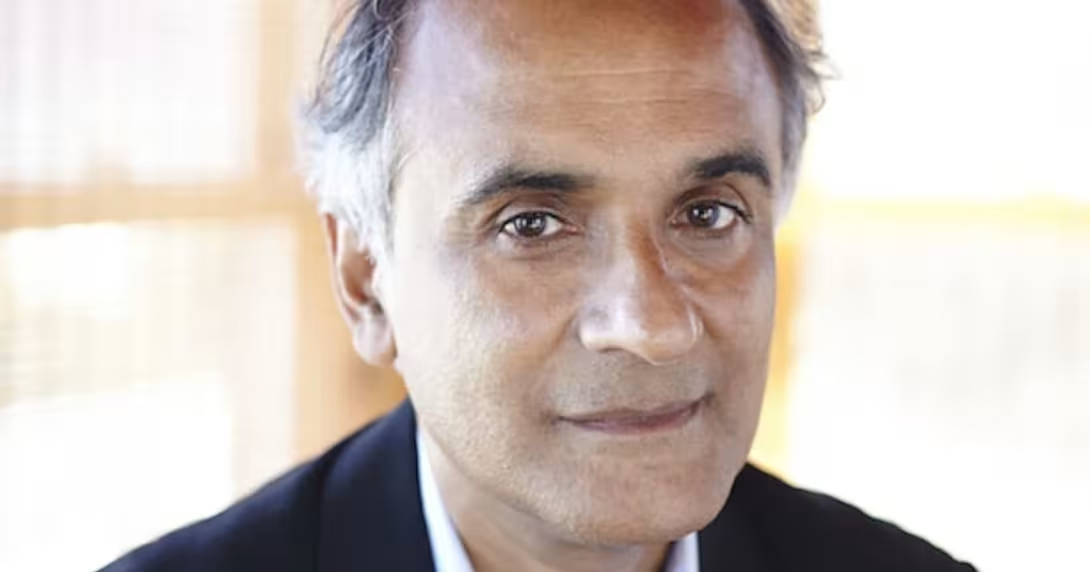
Japan’s evolving casino landscape reflects a careful balance between economic ambition and deeply rooted cultural attitudes. While the government advances plans to expand integrated resorts, including a major development in Osaka, public enthusiasm remains limited. Author Pico Iyer notes that gambling has never been central to Japanese society, despite strong participation in activities such as horse racing and pachinko. With new casino licences expected to be offered, Japan is positioning itself within the global gaming industry. However, the success of these initiatives will depend on how effectively policymakers align economic objectives with social acceptance and cultural sensitivities.
Cultural Attitudes Shape Japan’s Gambling Landscape
Japan’s approach to gambling is defined less by prohibition and more by cultural restraint. According to Pico Iyer, who has lived in the Kansai region for decades, casino-style gambling has not generated widespread excitement among Japanese citizens.
While social games such as mahjong are commonly played, they are rarely associated with high-stakes betting. This distinction highlights a broader societal tendency to separate recreation from gambling, influencing how large-scale casino developments are perceived.
Such cultural nuances remain central to the national debate as Japan cautiously expands its gaming sector.
Integrated Resorts Signal Policy Shift
Despite muted public enthusiasm, Japan is moving forward with integrated resort development as part of its long-term tourism and economic strategy. The flagship project in Osaka marks a significant milestone, reflecting the government’s willingness to embrace regulated casino operations within a broader entertainment framework.
Authorities are also expected to initiate bidding for two additional casino licences, signaling gradual expansion rather than rapid liberalization. These resorts are designed to combine gaming with hospitality, retail, and entertainment, positioning them as comprehensive economic hubs rather than standalone casinos.
Strong Betting Culture Outside Casinos
Although traditional casinos are a relatively new concept in Japan, other forms of betting enjoy widespread participation. Horse racing, for example, attracts significant wagering activity, with annual bets estimated at approximately Rs. 1.8 lakh crore, accounting for a notable share of global turnover.
This robust participation underscores a key paradox: while casino gambling faces cultural hesitation, regulated betting in specific formats is deeply embedded in the economy.
Pachinko, another popular activity, further illustrates this dynamic. Blending elements of gaming and gambling, pachinko parlours continue to draw millions of players across the country.
Pachinko and Pachislots: A Parallel Gaming Ecosystem
Pachinko and pachislots represent a unique segment of Japan’s gaming industry. These machines combine elements of chance and skill, often incorporating themes from manga and anime to enhance their appeal.
Players typically exchange winnings for prizes, which can later be converted into cash through indirect mechanisms. Despite its popularity, pachinko has historically occupied an ambiguous position within Japanese society.
Pico Iyer observes that pachinko is sometimes viewed as existing on the margins, with perceptions ranging from casual entertainment to semi-regulated activity.
Declining Visibility and Changing Trends
Over time, the prominence of pachinko parlours has diminished. Once a ubiquitous feature of urban life, these establishments are now less visible than in previous decades.
Pico Iyer recalls that the constant sound of pachinko machines was once a defining characteristic of shopping districts. Today, shifting consumer preferences and evolving entertainment options have reduced their dominance.
This transition reflects broader changes in Japan’s leisure economy, where digital entertainment and alternative experiences are gaining traction.
Economic Opportunity Versus Social Sensitivity
Japan’s cautious expansion into casino gaming is driven by economic considerations, including tourism growth, foreign investment, and job creation. Integrated resorts are expected to attract high-spending international visitors and generate substantial revenue for local economies.
However, policymakers must address concerns related to gambling addiction, social impact, and cultural disruption. The limited number of licences and strict regulatory oversight indicate a deliberate effort to manage these risks.
Balancing economic potential with societal expectations remains a central challenge.
Outlook: A Measured Path Forward
As Japan advances its casino strategy, the outcome will depend on public acceptance, regulatory effectiveness, and the performance of early projects such as the one in Osaka.
The country’s measured approach suggests that expansion will remain gradual, guided by both economic outcomes and social response. If successful, Japan could establish a unique model that integrates gaming within a culturally sensitive framework.
Ultimately, the nation’s experience highlights a broader global question—how to reconcile tradition with transformation in an increasingly competitive and interconnected gaming industry.
Comments