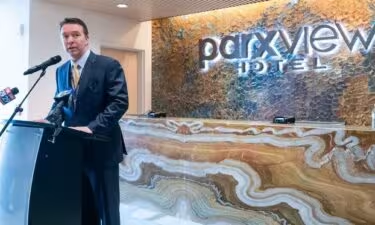
A newly redeveloped luxury hotel in Bensalem has opened at a pivotal moment as Philadelphia prepares to host a series of globally significant events, including the MLB All-Star Game, the FIFA World Cup, and the United States Semiquincentennial. The Parxview Hotel, developed from a fully reengineered legacy property, features 160 rooms and upscale amenities designed to attract international travelers. The project reflects a strategic investment in hospitality infrastructure, aligning with anticipated tourism growth and reinforcing the Delaware Valley’s position as a competitive destination for large-scale events.
Positioning for a Surge in Global Tourism
The launch of the Parxview Hotel underscores a calculated response to the expected surge in visitor demand across the Delaware Valley. With Philadelphia set to host multiple high-profile international events, regional stakeholders are accelerating infrastructure readiness to accommodate increased footfall.
Large-scale sporting and cultural gatherings historically drive elevated occupancy rates, premium pricing power, and extended visitor stays. By entering the market ahead of this demand curve, the hotel is strategically positioned to benefit from both immediate and sustained tourism inflows.
Comprehensive Redevelopment of a Legacy Asset
The property represents a complete transformation of a nearly 50-year-old structure previously operating as a mid-tier lodging facility. Rather than incremental upgrades, developers opted for a full-scale reconstruction—stripping the building to its structural core and rebuilding it in compliance with modern engineering and safety standards.
This approach reflects a capital-intensive repositioning strategy often employed in mature markets, where legacy assets are redeveloped to meet evolving consumer expectations. The result is a contemporary hospitality offering featuring 160 guest rooms, including 16 premium suites, tailored to both leisure and business travelers.
Integration with Entertainment Infrastructure
Situated adjacent to Parx Casino, the hotel benefits from immediate proximity to one of the region’s established entertainment hubs. This co-location strategy enhances the property’s value proposition by creating a seamless ecosystem where accommodation, gaming, dining, and entertainment converge.
Industry data suggests that such integrated models significantly improve customer retention and increase per-visitor spending. Guests are more likely to extend their stays and engage with multiple revenue streams, thereby boosting overall asset performance.
Leadership Perspective and Strategic Vision
Speaking on the development, Eric Hausler emphasized the ambition to establish a benchmark for premium hospitality in the region. The statement reflects a broader corporate strategy aimed at diversifying revenue beyond core gaming operations.
By investing in high-quality lodging infrastructure, operators can mitigate cyclical volatility associated with gaming revenues while capitalizing on the more stable dynamics of the tourism and hospitality sectors.
Economic Impact and Investment Outlook
Although specific financial disclosures remain limited, projects of this scale typically involve substantial capital deployment, often reaching several tens of crores (Rs.) when adjusted for comparable developments. The economic implications extend beyond direct revenue generation.
The hotel is expected to contribute to local employment, stimulate ancillary businesses, and increase tax revenues. Moreover, its presence strengthens the region’s capacity to host large-scale events, thereby enhancing long-term economic resilience.
Conclusion: A Forward-Looking Hospitality Play
The opening of the Parxview Hotel in Bensalem represents a forward-looking investment aligned with macro trends in global tourism and experiential travel. By transforming an aging property into a modern, integrated hospitality asset, stakeholders have positioned themselves to capitalize on a rare convergence of international events.
As Philadelphia steps onto the global stage, developments like this highlight a broader shift toward strategic, experience-driven infrastructure—where timing, location, and quality converge to define competitive advantage in the evolving hospitality landscape.
Comments