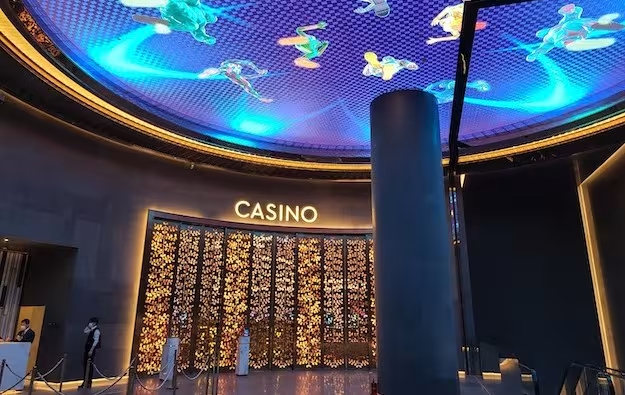
The upcoming NFL Draft in Pittsburgh is not only a major sporting spectacle but also a significant economic event, driving demand across hospitality and infrastructure sectors. Parking prices near key venues have surged sharply, with a leading casino offering a four-day parking package priced at over Rs. 41,500, reflecting the intense demand expected during the event. With hundreds of thousands of visitors anticipated, businesses are capitalizing on limited urban space and high footfall. The pricing strategy highlights broader trends in event-driven urban economics, where scarcity, convenience, and premium access combine to generate substantial short-term revenue opportunities.
Event-Driven Demand Reshapes Urban Pricing
As Pittsburgh prepares to host one of the most anticipated sporting events of the year, the National Football League Draft, the city’s economic landscape is undergoing a temporary yet significant transformation. Large-scale events of this magnitude typically generate a surge in demand for accommodation, transportation, and ancillary services. Parking, often overlooked in everyday urban planning, has emerged as a high-value commodity.
A prominent casino in the city has introduced a premium four-day parking package priced at approximately Rs. 41,500, inclusive of taxes and fees. The package offers continuous access over four days, underscoring how convenience is being monetized in a high-demand environment.
Pricing Strategy Reflects Supply Constraints
The pricing model reveals a calculated approach rooted in supply-demand economics. Urban parking infrastructure is inherently limited, and the influx of visitors—expected to run into the hundreds of thousands—places extraordinary pressure on available capacity.
While the advance package appears expensive, it is positioned as a discounted offering. According to the operator, the price represents nearly a 50 percent reduction compared to daily rates during the event. Visitors opting for single-day parking will face charges of around Rs. 20,750 per day, with stricter conditions including no re-entry and limited availability.
This tiered pricing strategy incentivizes early commitment while maximizing revenue from last-minute demand—a common tactic in high-demand event environments.
Digitalization and Operational Efficiency
Another notable feature of the parking arrangement is its fully digital, cashless system. Customers are required to purchase passes online, which are then delivered electronically and must be presented upon entry and exit.
This shift toward digital transactions reflects broader trends in operational efficiency and customer experience. By eliminating cash handling and streamlining access control, operators can manage higher volumes with reduced friction. It also enables better data tracking, allowing businesses to analyze usage patterns and optimize future pricing strategies.
Additionally, the inclusion of 24/7 in-and-out privileges for advance bookings enhances the perceived value of the package, appealing to visitors seeking flexibility during a multi-day event.
Regulatory and Access Considerations
The parking policy also incorporates specific regulatory measures, including age restrictions within the facility. Individuals under the age of 21 are not permitted in the parking structure unless accompanied by an adult. Such rules reflect compliance with broader regulatory frameworks governing casino premises.
While these restrictions may appear peripheral, they highlight the intersection of hospitality services and regulatory oversight, particularly in mixed-use commercial environments.
Economic Ripple Effects of Mega Events
The NFL Draft is expected to attract a massive influx of visitors, creating a ripple effect across the local economy. Hotels, restaurants, transportation services, and retail establishments are all poised to benefit from increased consumer spending.
Parking, in this context, serves as a microcosm of the broader economic impact. The ability to command premium pricing illustrates how temporary spikes in demand can unlock significant revenue streams. For businesses strategically located near event venues, such opportunities can contribute meaningfully to annual earnings.
From a macroeconomic perspective, such events reinforce the importance of infrastructure readiness and urban planning in maximizing economic benefits.
Consumer Behavior and Willingness to Pay
The success of high-priced parking packages ultimately depends on consumer willingness to pay for convenience. For many visitors, particularly those traveling from out of town, proximity to the event venue and guaranteed access outweigh cost considerations.
Behavioral economics suggests that in high-stakes, time-sensitive scenarios, consumers are more likely to prioritize certainty and ease over price. This dynamic enables businesses to implement premium pricing without significantly dampening demand.
Conclusion: A Case Study in Event Economics
The surge in parking prices during the NFL Draft offers a compelling case study in event-driven economics. It demonstrates how businesses can leverage scarcity, location, and convenience to generate substantial revenue in a short period.
As cities continue to host large-scale events, similar pricing dynamics are likely to emerge across various sectors. For Pittsburgh, the draft represents not just a celebration of sport but a powerful economic catalyst—one where even parking spaces become high-value assets.
Comments