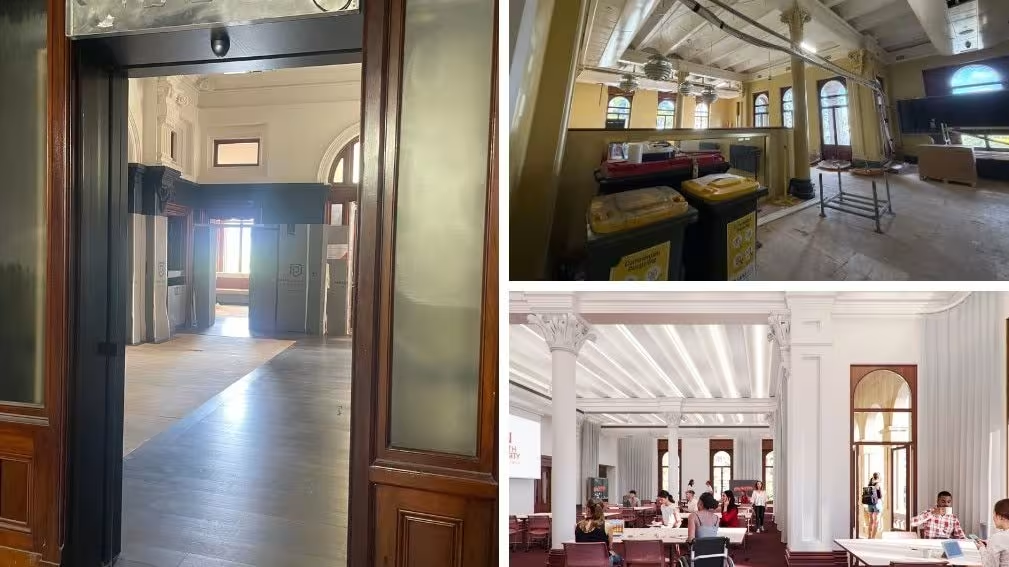
Griffith University has unveiled a pivotal phase in its ambitious redevelopment of the former Treasury Casino building into a state-of-the-art central business district campus. The multimillion-dollar project reflects a broader shift toward integrating higher education infrastructure within urban commercial hubs. By repurposing a legacy entertainment asset, the initiative aims to revitalize Brisbane’s CBD while expanding academic accessibility and innovation capacity. The transformation not only highlights adaptive reuse in real estate but also underscores evolving institutional strategies to align education delivery with urban regeneration and economic revitalization objectives.
Adaptive Reuse: From Casino Landmark to Academic Hub
The transformation of the former Treasury Casino building into a modern academic facility represents a sophisticated example of adaptive reuse in urban real estate. Rather than constructing a new campus from the ground up, Griffith University has opted to repurpose an iconic structure, blending heritage preservation with contemporary functionality.
This approach not only reduces environmental impact but also preserves the architectural legacy of a historically significant site. By reimagining the building’s purpose, the institution is contributing to a sustainable model of urban development.
Strategic Expansion into the Central Business District
Positioning a university campus within the CBD reflects a deliberate strategy to align education with economic activity. Central locations offer enhanced accessibility for students, professionals, and industry partners, fostering closer collaboration between academia and business.
For Griffith University, the CBD campus is expected to serve as a hub for innovation, research, and professional education. It also signals a shift in higher education delivery, where proximity to industry ecosystems becomes a critical advantage.
Catalyst for Urban Revitalization
The redevelopment project arrives at a time when Brisbane’s central business district is undergoing structural changes. With shifting commercial dynamics and reduced footfall in certain areas, large-scale institutional investments can act as catalysts for regeneration.
By converting a former casino into an academic space, the project is likely to drive increased activity, support local businesses, and contribute to a more diversified urban economy. Such initiatives demonstrate how educational institutions can play a transformative role in city planning.
Economic and Social Implications
Beyond infrastructure, the project carries broader economic and social implications. It is expected to generate employment during both construction and operational phases, while also attracting students and professionals to the area.
Additionally, the integration of education into the CBD may lead to the development of knowledge clusters, encouraging innovation-driven growth. This aligns with global trends where cities leverage academic institutions as engines of economic development.
A Milestone in Institutional Transformation
The opening of the site for public preview marks a significant milestone in the project’s timeline. It reflects tangible progress in what is likely to be a complex, multi-phase redevelopment effort.
Such transparency also helps build stakeholder confidence, showcasing the institution’s commitment to delivering a high-quality, future-ready campus that meets evolving educational demands.
Conclusion: Redefining the Intersection of Education and Urban Space
Griffith University’s redevelopment of the former Treasury Casino building exemplifies a forward-thinking approach to both education and urban planning. By merging heritage architecture with modern academic infrastructure, the project sets a benchmark for sustainable and strategic expansion.
As cities worldwide grapple with changing economic landscapes, such initiatives highlight the potential of educational institutions to drive meaningful urban transformation while advancing their own long-term growth objectives.
Comments