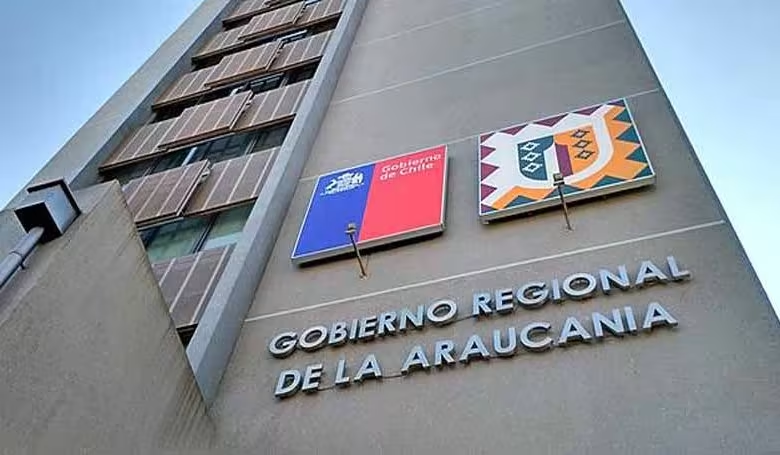
A proposal to establish a Mapuche-administered casino in Chile has ignited both optimism and skepticism across political, economic, and indigenous circles. While supporters view the initiative as an opportunity for economic self-determination and community development, critics warn of potential cultural dilution, regulatory challenges, and social repercussions. The plan, still in its early stages, represents a broader debate about indigenous autonomy and the economic future of Chile’s largest native group. As discussions unfold, the proposal highlights a complex intersection of sovereignty, entrepreneurship, and state oversight in the nation’s evolving economic landscape.
Background: A Bold Step Toward Economic Sovereignty
The Mapuche people, Chile’s largest indigenous community, have long sought greater control over their ancestral territories and resources. The proposal for a Mapuche-administered casino is seen as part of a broader movement toward economic independence. Advocates argue that the project could create jobs, promote tourism, and fund essential social programs within indigenous communities.
Proponents within the Mapuche leadership emphasize that the initiative represents more than profit—it is a means of reclaiming agency over development in their regions. With adequate regulation and cultural safeguards, they believe the casino could become a model of indigenous-led enterprise in Latin America.
Government Reaction: Balancing Inclusion and Regulation
The Chilean government has responded to the proposal with cautious interest. Officials acknowledge the potential for economic development but stress the need for a robust regulatory framework to prevent corruption, money laundering, and social harm associated with the gaming industry.
Government representatives have also underlined the importance of ensuring that revenues generated from the casino are transparently managed and reinvested in community welfare projects such as education, healthcare, and infrastructure. However, political observers note that the proposal’s success may hinge on its ability to align with national gaming laws and broader economic policy objectives.
For policymakers, the challenge lies in balancing indigenous autonomy with national oversight—ensuring that empowerment does not come at the expense of public accountability.
Cultural Concerns: Preserving Identity Amid Commercialization
While economic opportunity is a key motivator, some within the Mapuche community express concern that the casino could undermine traditional values and cultural cohesion. Critics argue that the introduction of gambling—a concept historically foreign to Mapuche traditions—may erode community integrity and invite social issues such as addiction and inequality.
Cultural leaders have urged caution, emphasizing that any commercial venture should reflect Mapuche ethical principles and collective decision-making processes. They argue that projects driven solely by financial gain risk replicating the very systems of exploitation that indigenous communities have historically resisted.
The debate reveals a broader tension between modernization and cultural preservation—an issue at the heart of indigenous economic development worldwide.
Economic Impact: Opportunities and Challenges Ahead
From an economic standpoint, the casino could inject substantial revenue into southern Chile’s regional economies, where the Mapuche population is most concentrated. Projections suggest that a well-managed gaming facility could attract domestic and international tourists, stimulate local commerce, and generate employment across sectors such as hospitality, transport, and crafts.
However, analysts caution that economic viability will depend heavily on regulatory clarity, transparent governance, and sustainable reinvestment strategies. Experiences from other Latin American nations show that indigenous-run enterprises succeed when they balance profitability with social and environmental stewardship.
If executed responsibly, the project could set a precedent for inclusive capitalism—demonstrating how indigenous entrepreneurship can coexist with national economic priorities.
Political and Social Context: Autonomy in a Divided Landscape
The proposal emerges amid renewed calls for greater recognition of indigenous rights in Chile’s political framework. Recent constitutional debates and social movements have amplified demands for autonomy, resource control, and equitable participation in the national economy.
For the government, supporting a Mapuche-administered casino could serve as a symbolic gesture toward reconciliation—an acknowledgment of indigenous capacity to manage complex enterprises. Yet for others, it raises uncomfortable questions about whether economic integration is being prioritized over genuine self-determination.
Social analysts suggest that the initiative’s reception will depend largely on transparency, community consultation, and the perceived fairness of profit distribution.
Looking Ahead: A Test of Vision and Governance
As discussions advance, the proposal for a Mapuche-run casino stands as a litmus test for Chile’s commitment to both inclusion and accountability. Its success would require cooperation between indigenous leaders, government regulators, and civil society organizations to ensure that the venture benefits local communities without compromising ethical or cultural values.
Beyond its immediate economic implications, the project symbolizes a deeper transformation in Chile’s social contract—where indigenous groups move from being beneficiaries of state policy to active architects of economic development.
Whether viewed as a bold stride toward empowerment or a risky experiment in commercialization, the proposal embodies the complexities of nation-building in a multicultural democracy. It challenges Chile to redefine prosperity not merely through profit, but through participation, dignity, and shared growth.
Comments