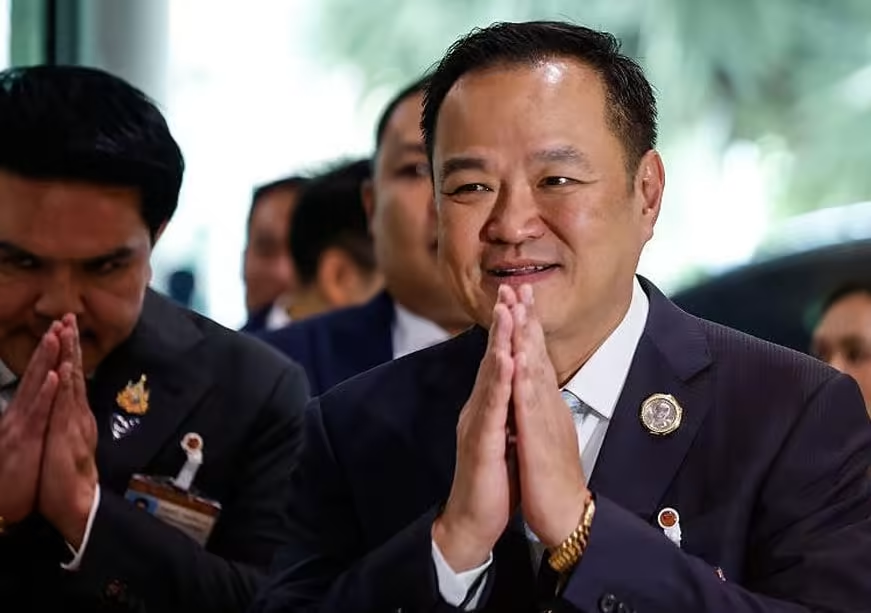
In a pivotal diplomatic exchange during the APEC Economic Leaders’ Meeting, Thai Prime Minister Anutin Charnvirakul reaffirmed that his government will not pursue the legalization of casinos, despite growing speculation about using gaming complexes to boost the economy. The “no casino” stance, reiterated directly to Chinese President Xi Jinping, underscores Thailand’s preference for sustainable growth through innovation, tourism diversification, and human capital development. The announcement not only clarifies the country’s domestic policy trajectory but also strengthens bilateral trust with China amid intensifying regional cooperation and evolving economic dynamics.
Thailand’s Firm Policy Stand
During high-level discussions with Chinese President Xi Jinping on the sidelines of the APEC summit, Prime Minister Anutin made it unequivocally clear that Thailand will not use casino legalization as a tool for economic recovery or investment attraction. His remarks came amid growing domestic debate over the potential establishment of integrated entertainment complexes that would include casinos.
According to the Thai leader, his government seeks to maintain a balance between economic growth and social stability, choosing not to embrace gambling-driven projects that could lead to regulatory complications or social repercussions. The reaffirmation of this stance effectively halts previous policy discussions that hinted at possible legislative amendments to permit casino operations.
Anutin underscored that Thailand’s long-term development strategy will focus on technology-driven innovation, value-added manufacturing, and the strengthening of human capital, rather than on short-term revenue from gambling-based entertainment.
Strengthening Diplomatic Ties with China
China welcomed Thailand’s decision, viewing it as aligned with Beijing’s own stance on limiting outbound gambling activities by Chinese nationals. President Xi reportedly expressed appreciation for Thailand’s position, emphasizing that cooperation between the two nations will continue to focus on legitimate sectors such as infrastructure, clean energy, digital trade, and tourism.
The reaffirmed policy removes a potential point of friction in bilateral relations. Given that many Southeast Asian economies have sought to establish casino resorts to attract Chinese tourists, Thailand’s refusal to do so signals a commitment to fostering sustainable and transparent economic partnerships.
For both governments, the conversation represented more than just a policy declaration — it was a reaffirmation of shared principles: curbing illicit financial flows, protecting social welfare, and prioritizing long-term regional stability over high-risk, high-reward economic gambits.
Economic Context: A Strategic Refocus
The decision comes at a time when several Southeast Asian countries are reassessing the balance between economic diversification and social responsibility. While neighboring nations like Cambodia and the Philippines have leveraged casino tourism as part of their economic models, Thailand has opted for a risk-averse, innovation-led approach.
Anutin’s remarks reflect a strategic reorientation: one that channels investment toward digital transformation, logistics infrastructure, and knowledge-based industries. Economists note that Thailand’s domestic product ecosystem — particularly in sectors like biotechnology, smart manufacturing, and sustainable tourism — offers more stable long-term growth potential than gambling-based development.
For investors, this policy clarity reduces uncertainty. It signals that the Thai government intends to attract capital through transparent regulation, predictable governance, and alignment with global ESG (environmental, social, and governance) standards — a priority for institutional investors worldwide.
Tourism Without Casinos: The Alternative Path
Instead of casino tourism, Thailand plans to strengthen its position as one of Asia’s most reliable and diverse tourism hubs. Prime Minister Anutin invited Chinese travelers to visit Thailand under renewed safety, security, and hospitality commitments.
The country aims to enhance its tourism offerings through cultural experiences, eco-tourism, and health and wellness travel — sectors that align with changing global preferences. According to government estimates, Chinese visitors are expected to remain Thailand’s largest tourist group, contributing significantly to foreign exchange earnings and small-business growth, even without the allure of casino resorts.
This “casino-free tourism” model complements Thailand’s efforts to promote ethical economic development, encouraging visitor spending that benefits local communities rather than foreign-owned gambling operators.
Implications for Business and Policy
From a financial and governance perspective, Thailand’s no-casino stance offers both advantages and trade-offs. While it forgoes the immediate tax revenues that could stem from gaming complexes, it also shields the economy from the volatility and social costs often associated with gambling industries — such as money laundering, credit risk exposure, and consumer debt accumulation.
Moreover, the decision aligns with the nation’s broader investment narrative — positioning Thailand as a low-risk, high-integrity market in an increasingly competitive ASEAN landscape. For international investors, this clarity provides confidence in the country’s regulatory consistency and policy predictability, both critical factors for long-term capital allocation.
Conclusion
Prime Minister Anutin’s reaffirmation of Thailand’s “no casino” policy during discussions with President Xi Jinping sends a strong message — both domestically and internationally. It is a declaration of principle: that Thailand’s economic growth will not be built on speculative or socially contentious foundations, but on innovation, discipline, and sustainability.
In an era where global economies are grappling with balancing growth and governance, Thailand’s position may well serve as a model for emerging markets striving to maintain social integrity while attracting investment. The outcome of this policy may not yield instant profits, but in the long arc of governance and nation-building, it represents a calculated bet on long-term resilience over short-term gain.
Comments