Macau-based gaming operator SJM Holdings Ltd. reported a staggering 91% drop in net profit for the third quarter of 2025, underscoring the mounting challenges facing the city’s traditional casino sector. The decline comes as the company continues to scale down its satellite casino operations, a segment historically central to its business model. The downturn reflects a combination of regulatory tightening, market consolidation, and shifting consumer behavior, as Macau transitions toward a more diversified, non-gaming economic framework. SJM’s results mark a critical inflection point for both the operator and the broader Macau gaming landscape amid ongoing structural transformation.
Profit Collapse Highlights Sectoral Pressures
SJM Holdings’ profit decline — a steep 91% year-on-year drop — is emblematic of the operational headwinds confronting Macau’s gaming sector in 2025. The company’s financials were weighed down by the progressive closure of satellite casinos, dwindling high-roller activity, and rising compliance costs under Macau’s revised gaming concession framework.
According to its financial disclosures, SJM’s earnings were further constrained by depreciation and interest expenses tied to its Grand Lisboa Palace resort, which, despite attracting steady visitation, has yet to offset losses from smaller, privately partnered venues. The operator’s revenue mix continues to evolve, shifting away from legacy satellite arrangements toward direct management of integrated resort properties.
Satellite Casino Contraction Reshaping the Market
For decades, satellite casinos formed the backbone of SJM’s business empire, operated through partnerships with independent property owners under its gaming license. However, a government-led restructuring of the concession system, implemented in 2022, has dramatically altered the model.
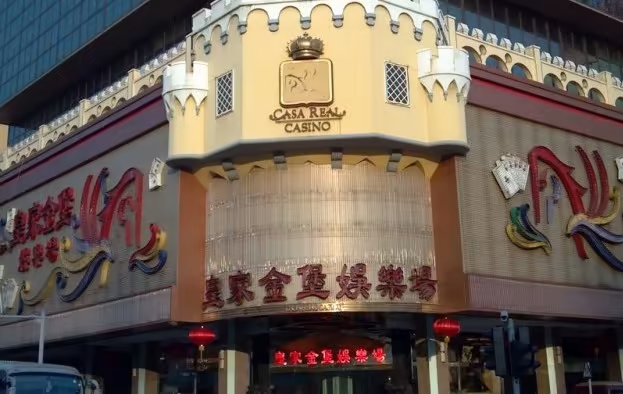
Under new rules, all gaming venues must be directly managed by licensed concessionaires, ending the long-standing practice of third-party management. As a result, several SJM-affiliated satellites — including Casino Casa Real and Casino Diamond — have either ceased operations or transitioned to non-gaming facilities.
This contraction has significantly reduced SJM’s market footprint, leaving it with just five operational satellite casinos. The move aligns with Macau’s broader policy shift toward regulatory transparency and centralized oversight, though it has also eroded short-term profitability for established operators.
Regulatory and Structural Shifts in Macau
Macau’s gaming industry is undergoing a period of structural recalibration as the government seeks to rebalance economic reliance on gambling. The new Gaming Law Amendment, emphasizing non-gaming investments and social responsibility, has required concessionaires like SJM to diversify their portfolios.
As part of this transition, SJM has committed to expanding its non-gaming offerings — including cultural events, retail spaces, and MICE (meetings, incentives, conferences, and exhibitions) facilities — within its flagship properties. However, analysts note that the financial returns from these ventures remain nascent, with high capital expenditures and delayed revenue realization.
Meanwhile, the continued absence of pre-pandemic VIP junket activity has compounded pressure on profit margins. The shift toward mass-market and premium-mass segments has helped stabilize visitation but yields lower per-capita spend, particularly in the context of rising operating costs.
Strategic Response and Long-Term Outlook
In response to these challenges, SJM Holdings has adopted a strategic consolidation plan aimed at operational efficiency and sustainable growth. Management has focused on optimizing its core assets — particularly Grand Lisboa and Grand Lisboa Palace — while gradually exiting low-margin satellite operations.
The company is also exploring opportunities in digital transformation and data-driven marketing to enhance customer engagement. By aligning its strategy with Macau’s tourism diversification goals, SJM aims to position itself as a resilient player in a post-satellite, integrated resort-driven environment.
However, recovery is expected to be gradual. Analysts forecast modest revenue improvement in 2026, contingent on the pace of tourism recovery from mainland China and the successful rollout of non-gaming initiatives.
A Defining Moment for Macau’s Gaming Evolution
SJM’s profit plunge underscores a deeper industry transformation in Macau’s post-concession era. The decline of satellite casinos — once a hallmark of the city’s gambling expansion — signals a turning point in how gaming businesses will operate in the future.
While the short-term impact is undeniably painful, the regulatory reset aims to lay a foundation for sustainable growth and better governance. For SJM, the path forward lies in balancing innovation with tradition — leveraging its historic brand legacy while adapting to the new economic realities of Asia’s premier gaming hub.
Comments