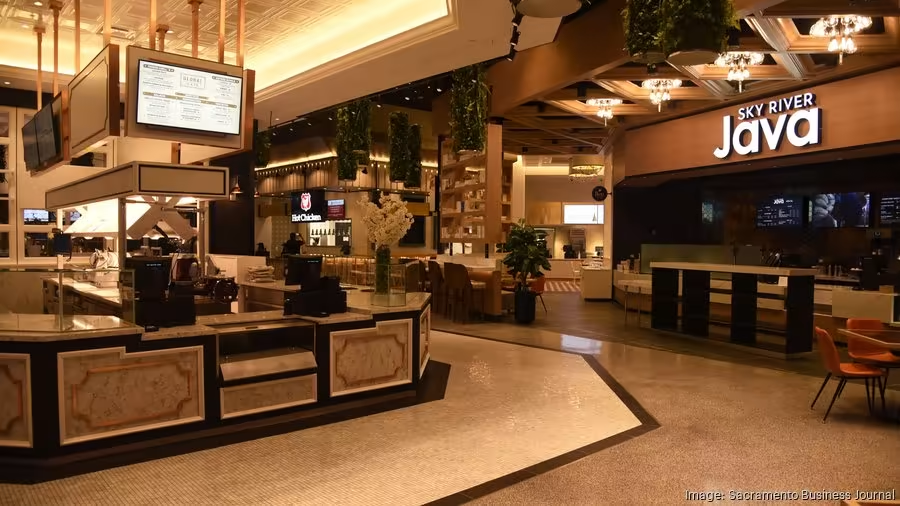
The labor dispute at the Wilton Rancheria-owned and in California spotlights a broader conflict between tribal self-governance and organized labor’s efforts to unionize gaming operations. A collective bargaining agreement signed in 2017 is now at odds with a subsequent 2019 tribal ordinance establishing new certification procedures for union recognition. The tribe contests an arbitrator’s decision that the 2017 agreement governs, claiming it undermines the tribe’s sovereign right to dictate its labor relations. As the case advances in federal court, it raises fundamental questions about the limits of tribal law, the reach of labor organizing, and how gaming compacts interact with labor governance.
Background: The Dispute Unfolds
In 2017 the Wilton Rancheria and Sky River Casino entered into a memorandum of agreement with the union UNITE HERE that established a card-check process for union certification among certain employee classifications.
In 2019 the tribe enacted its own Tribal Labor Relations Ordinance (TLRO), which provides a two-step certification process—card‐check plus secret ballot—and designates the tribal labor panel as the dispute resolution body.
The crux of the dispute: which set of rules applies—the older agreement or the newer ordinance? An arbitrator found the 2017 agreement governs, but the tribe now seeks judicial review, arguing the arbitrator exceeded authority and bypassed the tribe’s sovereign labor code.
Sovereignty vs. Organized Labor: Legal and Governance Implications
This dispute touches on fundamental legal doctrine. Under the Indian Gaming Regulatory Act (IGRA), gaming compacts between tribes and states must include “gaming-related” provisions. Labor relations generally lie outside the compact’s direct gaming regulation.
Tribal governments maintain sovereign control over internal matters—especially labor governance on tribal lands. The tribe argues that allowing external labor certification schemes would erode its self-determination.
On the other side, the union and its supporters contend workers deserve access to collective bargaining rights and that agreements entered into voluntarily should be enforceable—regardless of subsequent tribal ordinances. The legal tension thus lies in reconciling tribal sovereignty with worker organizing rights in the context of a commercial gaming enterprise.
The Casino Setting: Stakes and Strategic Context
Sky River Casino is operated under the Wilton Rancheria compact and serves a multibillion-dollar gaming environment. While specific financials of the dispute are not publicly disclosed in full detail, internal filings cite 2023 revenue for the casino at approximately US$68 million.
For the tribe, preserving control over labor relations is seen as preserving operational flexibility, risk management, and the unique governance structures of a tribal enterprise. From the union’s standpoint, this case offers a precedent for organizing workers in tribal-owned casinos across the country.
Recent Developments and Court Action
In August 2024 a U.S. federal district court denied the tribe’s motion to dismiss and granted the union’s motion to compel arbitration under the 2017 Agreement.
More recently (August 2025) the tribe filed a petition pointing to an arbitrator’s award in favor of the union and asking the court to vacate the decision, asserting the arbitrator erred by applying the 2017 Agreement rather than the tribe’s sovereign TLRO.
The case remains pending, with implications for tribal labor policy and the interpretation of labor agreements on tribal lands.
Implications for the Gaming and Labor Sectors
For Tribes and Operators:
- The case could influence how tribal governments draft labor ordinances in gaming compacts and structure labor governance separate from state or federal labor laws.
- It may prompt tribes to review existing collective bargaining agreements in light of later-enacted tribal labor statutes.
- Gaming operators that partner with tribes must consider the interplay of sovereign tribal labor law,-existing agreements and union organizing pressure.
For Workers and Unions:
- A ruling in favor of the union could pave the way for more organized labor efforts within tribal gaming operations, altering cost structures and labor relations dynamics.
- Conversely, a ruling favoring the tribe may reinforce tribal sovereignty in labor matters and limit third-party organizing in tribal enterprises.
Broader Industry:
- The intersection of tribal sovereignty, labor rights, and gaming regulation remains a sensitive domain—one that could shape policy for tribal-state compacts and jurisdictional frameworks under IGRA.
- Regulators and policymakers will closely observe the outcome as it may inform future gaming-compact negotiations, particularly those involving labor relations clauses.
A Jurisdictional Crossroads
At the heart, the Sky River dispute is a jurisdictional crossroad: does a tribal enterprise adhere to a prior collective bargaining agreement, or does its own sovereign labor code supersede? For stakeholders—including tribal leadership, casino operators, workers, and unions—the outcome could chart new terrain in labor governance for tribal gaming.
This legal contest is not just about one casino or one tribe—it is emblematic of how sovereign tribal rights interface with labor organizing and commercial gaming in the United States.
Comments