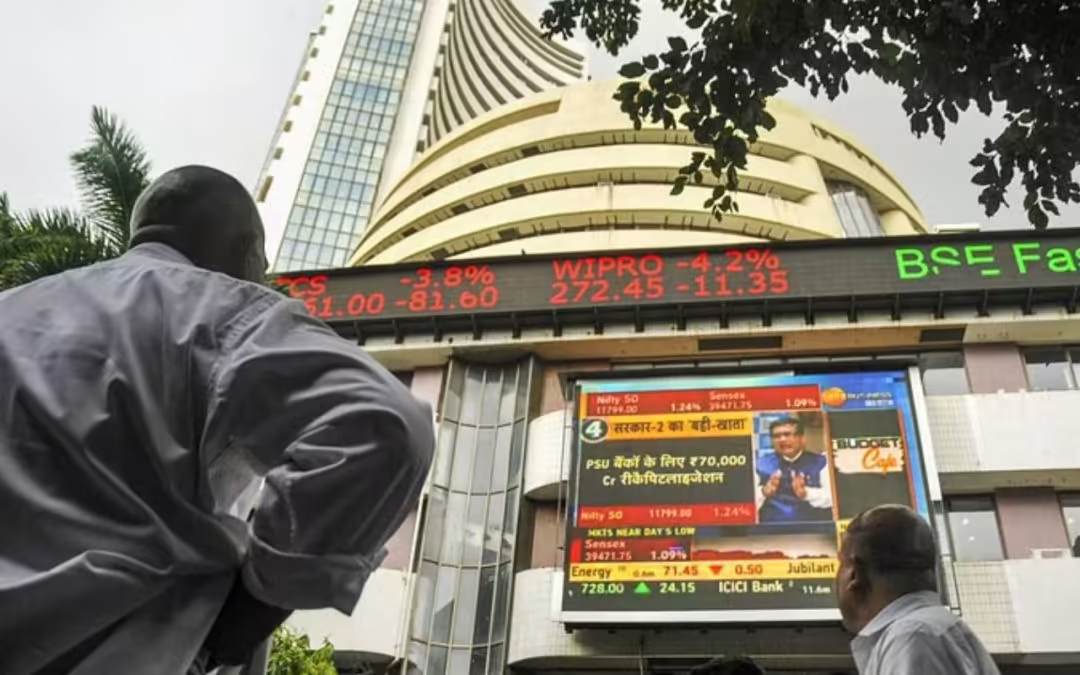
India’s gaming and casino sector faces heightened uncertainty after the government proposed raising the Goods and Services Tax (GST) on casinos from 28% to 40%. The announcement has triggered immediate market repercussions, with shares of leading listed gaming companies sliding sharply. Industry players argue that the move could dampen investment, shrink consumer participation, and weaken the long-term viability of the casino and gaming ecosystem. While the government justifies the increase as a revenue-enhancing measure, analysts warn it may deter formalization, drive demand underground, and hinder a sector already under regulatory strain.
Market Reaction and Stock Performance
The stock market responded swiftly to the proposal, with major gaming counters experiencing steep intraday declines. Investors, spooked by the higher tax burden, sold off shares of companies with exposure to casino and gaming operations. Market capitalization across the segment eroded by billions of rupees in a single trading session, reflecting widespread concern over the industry’s growth outlook.
Government’s Rationale
The proposal to increase GST from 28% to 40% is being positioned as a revenue-maximization strategy at a time when fiscal consolidation remains a government priority. Officials argue that the casino industry, often viewed as a luxury consumption category, has the capacity to bear a higher tax incidence. By raising the levy, the government expects to generate significant additional revenue inflows, which could support infrastructure spending and welfare schemes.
Industry Pushback
Casino operators and gaming industry stakeholders have voiced strong opposition, labeling the proposal as excessive and counterproductive. Industry representatives argue that the current 28% GST is already one of the highest globally, and further escalation risks making India’s gaming market uncompetitive. There are also concerns that higher taxation will discourage foreign investment, reduce footfall at licensed casinos, and push consumers toward unregulated platforms, depriving the government of revenue instead of enhancing it.
Economic Implications
Economists and market analysts are divided over the long-term impact. On one hand, higher taxation could strengthen public finances. On the other, the measure may erode industry profitability, suppress job creation, and discourage the formalization of an already sensitive sector. The risk of shifting demand to offshore or illegal channels also looms large, potentially undermining the regulatory framework the government has sought to build in recent years.
Investor Outlook
Brokerages have downgraded outlooks for companies with significant exposure to gaming and casino operations, citing uncertainties over earnings visibility. Market experts recommend a cautious approach, highlighting that if the proposal passes into law, valuations in the sector could undergo a major reset. The industry, already grappling with compliance costs and regulatory hurdles, may find the additional tax burden difficult to absorb without passing costs on to consumers.
Conclusion
The government’s move to hike GST on casinos to 40% has rattled investors and reignited debate over taxation policy in the gaming sector. While policymakers view the industry as a lucrative source of tax revenue, stakeholders caution that excessive levies could stifle growth and fuel the underground economy. As the proposal progresses through policy channels, the casino sector braces for a period of heightened uncertainty, with both investors and operators awaiting clarity on the final outcome.
Comments