China

By Josh Pearson , 7 April 2026

China maintains one of the strictest anti-gambling regimes globally, prohibiting casino operations across mainland territories while simultaneously benefiting from controlled exceptions such as Macau. This dual structure reflects a deliberate state policy aimed at minimizing social risks while leveraging gaming as a strategic economic tool. Despite tight enforcement, underground gambling and offshore platforms continue to challenge regulators. Meanwhile, Macau remains a global gaming powerhouse, contributing billions in revenue.
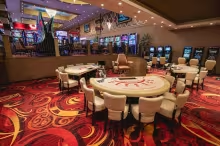
By Josh Pearson , 18 March 2026

Casino gambling remains a heavily regulated activity across the world, with several countries maintaining strict bans on casino operations due to cultural, religious, and legal considerations. While many nations have embraced regulated gaming industries as sources of tourism and tax revenue, others continue to prohibit casino gambling entirely or impose severe restrictions. These bans are often rooted in concerns related to social welfare, religious principles, and financial oversight.

By Josh Pearson , 4 March 2026

In mainland China, casino gambling is illegal. Yet just across the Pearl River Delta lies the world’s largest gambling hub: Macau.

This paradox defines China’s gaming structure. While Beijing prohibits casinos domestically, Macau — a Special Administrative Region — operates under a distinct legal and economic framework inherited from its Portuguese colonial past.

By Josh Pearson , 2 March 2026

China’s casino industry, centered primarily in Macau, is navigating a complex transition shaped by regulatory recalibration, economic moderation and shifting consumer behavior. Once the world’s largest gaming hub by revenue, Macau has experienced dramatic swings in gross gaming revenue over the past several years due to policy reforms and pandemic-related disruptions. While visitation has gradually recovered, the sector is redefining its growth model by prioritizing mass-market tourism, non-gaming amenities and stricter compliance oversight.

By Josh Pearson , 25 February 2026

China maintains one of the strictest anti-gambling regimes in the world, criminalizing most forms of wagering while tightly controlling the few exceptions permitted under state supervision. Rooted in social stability concerns and capital control policies, Beijing’s approach combines domestic prohibition with aggressive enforcement against overseas and online gambling operations targeting Chinese citizens. At the same time, government-run lottery systems provide a regulated outlet for gaming demand and a steady stream of public revenue.

By Josh Pearson , 23 February 2026

Casino gambling in China presents a paradox of prohibition and prosperity. While mainland China enforces strict bans on most forms of gambling, the Special Administrative Region of Macau operates as the nation’s only legal casino hub. Over the past two decades, Macau has transformed into the world’s largest gaming center by revenue, surpassing Las Vegas at its peak. However, regulatory tightening, economic shifts, and policy reforms have reshaped the industry’s trajectory.

By Josh Pearson , 19 January 2026

Cui Lijie, a prominent Chinese billionaire and influential figure in the international casino industry, was apprehended by U.S. Immigration and Customs Enforcement (ICE) at Saipan airport in the Northern Mariana Islands. Cui, renowned for her extensive holdings in Macau and other Asian gaming markets, faces unspecified federal charges related to financial and regulatory compliance. Her arrest has sent shockwaves across the global casino and investment community, highlighting increased U.S. scrutiny of international gambling and finance activities.

By Josh Pearson , 6 December 2025

China’s casino tourism market has experienced a turbulent yet transformative decade marked by rapid expansion, sharp decline, and a measured recovery. Macau—the core of China’s gaming ecosystem—saw unprecedented growth early in the decade, fueled by rising disposable incomes and a booming VIP sector. However, regulatory tightening, anti-corruption measures, capital controls, and global disruptions led to significant downturns. In recent years, the region has rebounded, driven by a diversified tourism strategy, mass-market players, and supportive economic policies.

By Josh Pearson , 6 December 2025

China’s stringent gambling laws have played a defining role in shaping the evolution of Macau, the world’s most prominent casino hub. As gambling remains illegal on the Chinese mainland, Macau operates as a regulated exception, functioning under a unique legal framework that balances economic ambition with political oversight. These restrictions have influenced Macau’s licensing rules, tourism flows, investment strategies, and compliance requirements.

By Josh Pearson , 11 November 2025

Thailand’s tourism sector is facing a pivotal moment as the number of Chinese visitors—the country’s largest foreign tourist group—declines sharply. Industry stakeholders are advocating strategic reforms, including potential casino legalization, to bolster visitor numbers and diversify revenue streams. The debate around gambling has intensified amid concerns over social impacts, regulatory frameworks, and economic benefits.